
2 Likes
Spelling is one thing, but pronunciation is where it really gets strange. Words like “through” and “though” look nearly the same yet sound completely different, and place names can be even worse. It makes me wonder how anyone learns this as a second language without constant frustration. The spelling rules seem to have just as many exceptions as examples.
2 Likes
The through/though contrast is a good example of how much English pronunciation depends on history rather than consistent rules. A lot of these spellings preserve older sounds that shifted over time, which is why the patterns feel so uneven. Place names add another layer because local usage often overrides any general logic. For learners, I think hearing words in context repeatedly matters more than trying to derive them from spelling, though that does make the early stages slower.
If you think English is bad now, wait until you visit the Midwest USA. In Ohio, the town that built the world’s most advanced heavy-haul fast-freight steam locomotive, the Berkshire, and the most basic design of a logging locomotive, the Shay, is pronounced Lie-ma. But in Peru, it is pronounced Lee-ma. If you pronounce it Leema in Ohio, you will be assumed to be a foreigner from New York City who is easily spooked by cornfields. Why? Because you watched too many Midwest-based cornfield stalker movies created by Hollywood when you were a child.
Why is this? A heavy pre-America French woody-outdoorsy explorer and trapper influence combined with the languages of the numerous assorted local tribes. Then add a very heavy German, Czech, and Polish farmer influence and start mixing.
Another one is Elgin, IL with the soft G and Elgin, TX with the hard G. But Elgin, IL is correct if you know anything about Elgin National watches and how entire railroads used them to schedule train meets at sidings instead of cornfields.
Why is this? It is a Texas problem unique to Texas. There is an old law in Texas that says everything in Texas must be unique to Texas. Thankfully, it was revoked by the time they named Dallas, because there is a Dallas, PA.
English is very easy to learn the basics of, and to be able to communicate on a rudimetry level, but to step up to being a master of the language takes talent, skill and experience. Pretty much the opposite of, say, German, which is very hard to learn the basics of, but once you know them, it isn’t too big of a step to master it.
The point about Ohio’s Lima versus Peru’s is a good reminder that local usage really does override general rules, and the French, tribal, and later German/Czech/Polish layers you mention explain a lot of Indiana place names too. I’m in Indianapolis, and we have our own quirks, like Versailles being pronounced ver-SALES. The German comparison is interesting as well: strong early structure versus English’s slow accumulation. For learners, I’d agree that repeated exposure in context beats trying to reason from spelling.
Yup, It has many not so obvious rules. So if you learn it only at shool as a second language, watch English / american movies and have little to no chance to use the language extensively for longer periods you have no chance to master it.
That goes for any other language as well. Can I communicate in English sure I can. But with caveat … i make stylistic and grammar mistakes. I shit tone of them to be fair. Im fully aware that I may sound like im struggle with my words for natives or somewhat (caveman )retarded even. And im ok with that.
Sometimes I read post of a literal natives here. And I must read it 2-3 times. Here is the cach, English is structurally way different then any slavic language. So I read the sentence, I know the words, I know what that order of words should mean yet… they have no sense at all at the first glance. So my Slavic brain needs few other glances to process wtf I just have read. The best part of it is, it’s not annoying it is fun. In a conversation, this can be tiring for both me and the person I’m communicating with. And that is a bit sad part of it.
Ps There are more mistakes in this post than I think it is, of that I’m sure
3 Likes
No worries, grafti. You do better than some “native” English speakers I know.
Even for people that know their English very well, the language allows for higly ambiguous statements:
“An abandoned man’s shirt…”
Does that mean a man’s shirt that has been abandoned, or does it mean a shirt belonging to a man who has been abandoned?
Nobody knows.
2 Likes
I am always surprised how well you guys do pick up English. Literally every rule is broken in this language, the spelling is atrocious, and arguably the most descriptive language there is, meaning there are many words for the same thing. If there isnt we just steal a word and it is ours.
It is amazing you guys do as well as you do. Compare that to me learning Polish, it aint gonna happen.
2 Likes
@LinNoob It is not even the case how well we pick up english but why it goes “that” way. Somewhat let say “key” to maintain some degree of communicative English skill is the fact that it is literally everywhere.
If you go to concert in Poland or any non English speaking country in the world (if we assume it’s not some local star nor Rammstein) you will hear English from the stage. Same goes with movies (if they are not dubbed by voice actors), any sort of technical documentation, freaking forums, Reddit and so on. If it was other way around, let say polish would be everywhere You would have no problem to learn a communicative basics of it :).
It’s all boils down to degrees of exposure to /something/ in this case a language.
1 Like
I realized that I had forgotten my keys.
God why 
The teacher said that the Earth revolves around the Sun.
or
The teacher said that the Earth revolved around the Sun.
Both sentences have exact same meaning yet for Slav ear the second sentence literally means that, earth revolves around the sun in the past then, all of a sudden it stops doing that.
Excuse me! Can we call a necromancer to resurrect some damn Nicolaus Copernicus for a minute or something 
Thats also crazy
- „Where is my coffee?”
- „I was drinking it”
It means i drunk my cofee to the last drop. There is no coffee in the cup at all. Yet for slaw it literally means that i put my cofee cup down with some cofee in it and i will get back to it later.
That last one puts my brain in mad man schizo mode every time no exceptions.
I had drunk the coffee when the phone rang.
So In the past when the telephone ranged my coffee cup was already empty. There was no damn coffee in it.
Yet … what I read and understood by that goes like this: sometime in the past i drinking my a coffee while telephone start ringing. So there was still some coffee in a cup while i heard the phone

There is a tone of this kind of traps in English.
If one do not use the language daily around regular people there is no way to escape those traps. This leads to a whole bunch of ridiculous misunderstandings
1 Like
It depends. Was he out deer hunting in Wisconsin and it was an unseasonably warm day? Or did his wife run off with another man?
For more interesting answers, ask AI and watch the smoke come out of its virtual ears.
Now do Marseilles, IL. Same thing. Different spelling. In the Midwest when it comes to French, it must be butchered. That’s the law. Unless it somehow escaped.
Another example, Bois Blanc Island, Michigan. That’s Bob Low’s Island. Nearby is the Mackinac Bridge, Mackinaw City, and Mackinac Island. Why? Two are French. One is British. All are pronouced Mackinaw.
But its fine to refer to the bridge as the Mighty Mac. If you ever go over it with 79,000 pounds, following a truck hauling almost 168,000 pounds, in December, in snow, in high wind, and the bridge is otherwise closed to everyone else, with a laker 250 feet down below the see-through steel grate deck heading for Indiana Harbor, Gary, or Burns Harbor, you know why.
A few miles north, Sault Ste. Marie. Both Ontario and Michigan. It is pronounced Soo Saint Marie. The Soo will work too. Just as the Minneapolis, St. Paul, and Sault Ste. Marie Railroad was called the Soo Line and everybody goes there to see the Soo Locks.
What were General Custer’s last words?
“Man, these Siouxs are killin’ me!”
1 Like
“The problem with defending the purity of the English language is that English is about as pure as a cribhouse whore. We don’t just borrow words; on occasion, English has pursued other languages down alleyways to beat them unconscious and rifle their pockets for new vocabulary.”
–James D. Nicoll
2 Likes
ho lee fuk that hits hard
“Man, these Siouxs are killin’ me!” <— exactly something like this. Words play
I need to read this few times to get this
Something completely different but

1 Like
Don’t let Sioux City Sue hear you say that.
Yes, there is a song by that title. And she is a redhead, so look out.
1 Like
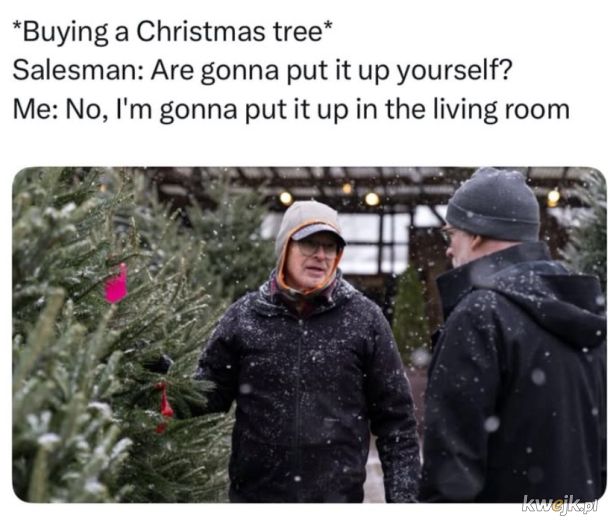
That qualifies as an Upper Midwest joke. Or some scene stolen from a movie, such “A Christmas Story,” “Fargo,” or “Grumpy Old Men.”
The best Christmas trees were the ones you found out in the woods about a mile in, while cutting firewood from old, dead trees. You cut it down yourself, loaded into the old mostly worn-out Huebner manure spreader now converted into a firewood trailer, and hauled home with the Massey Ferguson 35 tractor because no four-wheel-drive anything could get in there without getting stuck.
Buying a tree from a salesman was a city thing.
Buying a tree from a boat captain with his own two-masted schooner tied up in the Chicago River was a Chicago thing.
Or….