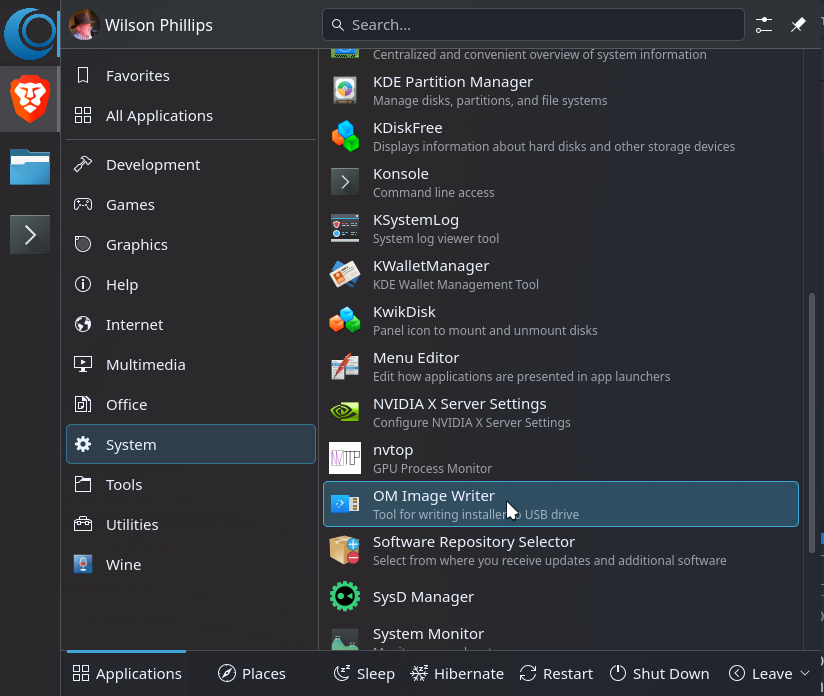
I’m having trouble getting the iso of openmandriva rome to run on my main desktop computer.
The image boots without any problem on my hp pavilion laptop and an older desktop computer with a 4th generation i5.
On my main computer I can’t do it I will add that I have a msi b450 tomahawk max motherboard. I have tried various options like resetting the bios, uploading the latest bios, disabling secure boot of course. I used ventoy as well as recorded the image separately on another flash drive with no results.
Other distributions like cachy os, ubuntu, mint, etc work without problems.
I know that there have been others who have had issues booting into the live iso. You mentioned ventoy, and there have been others with the same problem. Search around on the forums for ventoy, and you should find what you’re looking for.
As for the other flash drive, what program did you use to flash the iso to the usb drive?
The image loads something but does not load the desktop like on my laptop and older desktop. I am not talking about installation but only loading the iso image to the desktop.
When I asked for version, I actually meant the actual version number. Telling me it is ROME, does not tell me how old it is. Certain versions had issues with Ventoy and image writing tools.
I do understand that asking questions seems like I am prying, but we don’t know what we don’t know. We can’t just guess.
If you use other usb-writing tools as some Windows tools (e.g. Rufus) you must select the ‘dd’ mode otherwise it will truncate the volume name and break the boot process.
Yes this was the solution for me as well, kept scratching my head on what was going wrong, lots of console text errors
Maybe issue with old computers, its a dell optiplex 755 desktop with x3363 xeon upgrade, maxed out old office machine.
bad ocr, not meant to be code as its ocr garbage from a photo of the screen i took.
"
(outside disabled by BIOS
'dewdisk/by-uuid/2B2S-%-15-11-56-4e-ee does not exist
krning: does exist
.txt"
Entering eærgency nde. Exit the shell to continue.
Type “Journalctl” to Vieu system logs.
You might want to sa•…e
after nunting then and attach it to a bug report.
to a lßB stick or
Cannot open
See suiogin(8)
Press Enter to
to console, the root account is locked.
•an page for nr•e details.
contimte."
I have a USB installer made with Ventoy and OML Rock 6.0, just downloaded last week.
I’ve read about some issues mounting an NTFS partition here, we’ll see how that goes.
Just have a few more things to back up, and I figure I’ll do the install tomorrow.
I may make some package requests, like SPEK audio analyzer, Dune3D CAD, and maybe a few others if I cant find them in the repo.
Would the good people who are building packages prefer if I just learned to compile from source? I’m VERY rusty, but I figure I could do it, eventually.
Once I’ve gotten used to CLI again, I may try my hand at building packages.
I looked here:
…and I figure I could eventually do it, first just locally, then I’ll jump through the hoops to be able to add them to the repo, it’ll take time, though.
I have been slowly learning how to make rpm spec files. It isn’t hard, just a bit time consuming. If you could package them for the OM repo that would be ideal. I would say to go ahead and submit a package request at the OM github page, one of us might get to it before you do.
If you are talking about installing then do not use NTFS that makes no sense. The only file system types recommended are the default ext4, plus btrfs, f2fs, or xfs.
If you want to have an ntfs partiton mounted at boot you will need to use Manual Partitioning, select that partition, select ntfs from the file system list, and if you want you can label it but that is optional. I think that should work anyway. I do not use ntfs.
If you run in to problems be aware of these articles. Including this one which you may want to read before installing:
I’m currently on windows. I’ll re-format most of my drive as ext4, but a smaller NTFS partition is where I’ve stored a bunch of stuff. It’ll be neat to see if I can import bookmarks from an .html file on an NTFS partition into an instance of Brave running on an ext4 partition.